
Views: 2187 Author: Site Editor Publish Time: 2026-03-26 Origin: Site


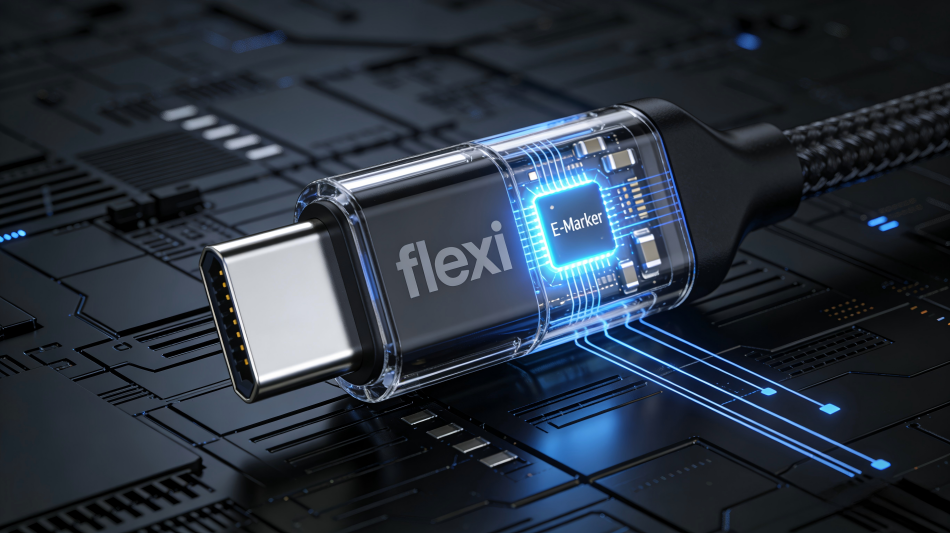
The E-Marker chip is the core identity authentication module of USB-C cables, serving as the legally mandated technical standard to ensure secure device communication, full performance release, and cross-ecosystem compatibility.
USB Type-C was designed to be a comprehensive interface. It can deliver substantial electrical power to charge everything from a smartphone to a high-performance laptop. It can transfer data at incredible speeds, connecting you to external storage and peripherals. It can even carry high-resolution video signals to external displays. This convergence is driving its market dominance, with the global USB Type C market projected to grow from USD 33.4 billion in 2025 to USD 139.6 billion by 2035. The goal was simplicity: one port, one cable, endless possibilities.
The E-Marker chip acts as the cable's digital ID, facilitating a 'handshake' between devices to negotiate the highest safe power and data speeds.
The chip is an ultra-small precision electronic component (millimeter-scale in size), which cannot be directly observed with the naked eye and belongs to an internal hidden design within the cable terminal.
| Function Category | Specific Function | Key Parameters Stored |
|---|---|---|
| Identity Identification Function | Act as the "electronic ID card" of the cable, uniquely identify the cable identity and associate all specification parameters | 1. Cable model and specification number2. Corresponding USB protocol version (e.g., USB 3.2, USB4)3. Certification standard (USB-IF certification mark) |
| Performance Parameter Storage | Store the full-dimensional performance upper limit of the cable for accurate reading and matching by devices | 1. Charging power: rated power such as 60W, 100W2. Data transfer rate: 5Gbps, 10Gbps, 40Gbps3. Video transmission support: compatibility with DP Alt Mode, 4K/8K resolution, refresh rate (60Hz/120Hz) |
| Safety-Related Function | Bind the safe bearing threshold of the cable to provide data support for the device protection mechanism | 1. Maximum current bearing capacity (3A, 5A)2. Maximum voltage bearing capacity3. Safe operating temperature range |
When cables are inserted into devices (computers, mobile phones, chargers, monitors), the device's CC pin (Configuration Channel) automatically triggers a communication handshake with the E-Marker chip.
The chip within the terminal immediately responds to device query requests, providing feedback on identity and parameters with no delay.
The device accurately reads parameters such as the cable's 100W power and 10Gbps transmission rate, with no misjudgments or omissions.
· Match high-power mode: Deliver 100W fast charging to the laptop without downgrading.
· Match high-speed transfer mode: Support 4K video transmission + data synchronization transfer.
· Match safe mode: Trigger device overcurrent/overvoltage protection thresholds based on chip parameters.
If the device load changes, the chip provides real-time feedback on the current load-bearing capacity, and the device dynamically adapts its power/ rate to avoid overload.
Safety is the core value of the E-Marker chip
Low-quality USB-C cables without E-Marker chips cannot be recognized by devices for their actual power delivery capabilities. This may result in low-power cables being incorrectly identified as high-power cables, potentially leading to cable overheating, short circuits, and even damage to connected devices such as mobile phones, computers, and chargers.
The USB-C interface exhibits strong universality; however, there are significant differences in specifications among various devices and cables.
Cables equipped with E-Marker chips enable different devices such as computers, mobile phones, monitors, and chargers to quickly identify their specifications, achieving seamless adaptation. They can operate stably regardless of the type of compliant USB-C device connected, thereby avoiding various malfunctions.
The E-Marker chip complies with the official standards of the USB-IF (USB Implementers Forum), serving as an essential component for authentic USB-C cables, particularly high-power and high-speed variants. With the proliferation of next-generation interface protocols such as USB4 and Thunderbolt 4, new devices will impose higher specifications on cables. Flexible USB-C cables integrated with E-Marker chips can adapt to these next-generation devices, eliminating the need for frequent cable replacements and enabling 'one-time selection, long-term usability', thereby demonstrating strong future compatibility.
Using USB-C cables without E-Marker chips presents three core risks, all of which will have a significant adverse impact on device performance and user experience:
Misjudgment of cable specifications by the device may lead to cable overheating and short circuits, which can subsequently burn out the interfaces of mobile phones and computers, as well as damage chargers. In severe cases, this may result in safety accidents.
Even if the cable itself supports high-speed data transmission and high-power fast charging, without an E-Marker chip, the device will default to operating at the minimum specifications, resulting in a significant reduction in data transfer speed and the inability to achieve fast charging, thereby wasting the cable's inherent performance.
Cable without chips cannot be compatible with new USB-C devices, resulting in situations where the cable 'can be plugged in but not used' or 'can be plugged in but not used properly'. Particularly for high-end computers, professional monitors, and other devices, the cable may not be recognized directly, affecting normal usage.
The presence of an E-Marker chip facilitates the sophisticated negotiation process defined by the USB Power Delivery (USB PD) specification. This protocol enables devices to dynamically manage power, significantly surpassing the simple, fixed-wattage charging
USB Power Delivery enables a flexible and powerful charging system, with the potential to deliver up to 240 watts of power. However, transmitting such a high power level unconditionally through a cable is extremely hazardous. A cable not designed to handle this load could overheat, melt, or ignite, potentially damaging connected devices. This is why intelligence is critical. The USB PD protocol mandates negotiation between the power source and the device being charged (the sink) to establish a safe and efficient voltage and current level. The E-Marker chip in the cable is an essential component of this negotiation for any power level exceeding 60 watts (20V at 3A). The broader USB devices market is projected to reach USD 81.91 billion by 2030, primarily driven by the advanced capabilities enabled by standards such as USB PD.
Conceive the power negotiation as a three-way conversation. When a USB-C cable is connected:
The Source (Charger) Announces Its Capabilities:The charger sends a message over the CC line, listing all the power profiles it can provide (e.g., 5V/3A, 9V/3A, 20V/5A).
2. The Source Queries the Cable:If the source can provide more than 60W, it must first check the cable's rating. It sends a "Discover Identity" command to the E-Marker chip.
3. The E-Marker Responds:The E-Marker chip replies with its data packet, stating its maximum current capacity (e.g., "I am rated for 5A").
4. The Sink (Device) Makes a Request:The laptop, now aware of both the charger's capabilities and the cable's limits, requests a specific power profile that is safe for all three components. For example, if the charger can offer 100W (20V/5A) and the cable is E-Marked for 5A, the laptop can safely request that full power. If the cable lacked an E-Marker or was only rated for 3A, the negotiation would be capped at 60W (20V/3A), regardless of the charger's power.
An active cable incorporates signal-enhancing chips—like redrivers and retimers—within its connector heads to overcome the length limitations of passive cables. These chips actively reshape and re-transmit the data signal, allowing for high-speed connections over much longer distances.
• Capabilities: Active E-Marked cables make it possible to have a 2-meter (6.6 feet) or even longer Thunderbolt 4 or USB4 cable that still supports the full 40Gbps bandwidth. This is essential for setups where devices are farther apart, such as connecting a computer to a large conference room display or a rack-mounted server.
• Mandatory E-Marker:For active cables, the E-Marker is always mandatory, regardless of the rated speed or current. The internal electronics require power and must be managed by the host system. The E-Marker's data packet is expanded to include information about the type of signal conditioning circuitry inside, allowing the connected devices to communicate with it correctly.
The USB-C connector has unified our devices, but that unity comes with a critical caveat: the intelligence of the connection is only as good as the cable bridging the gap. The E-Marker chip is the unsung hero of this ecosystem, a tiny digital passport that verifies a cable's identity and capabilities, ensuring a safe, reliable, and high-performance experience. As we've seen, its role is not a minor technical detail but a non-negotiable foundation for modern technology.
To recap the core insights:
• Safety Interlock
The E-Marker is a mandatory safety feature for any charging scenario over 60W, preventing cable overheating and potential damage to your devices.
• Performance Gatekeeper
It is the key that unlocks the high-speed data transfer of USB 3.2, USB4, and Thunderbolt, as well as the high-resolution video of DisplayPort Alternate Mode. Without it, your high-end peripherals are throttled to a fraction of their potential.
• Eliminator of Frustration
It provides the clear communication necessary for the USB Power Delivery protocol to function, preventing the frustrating guesswork of why a device is charging slowly or a peripheral isn't working correctly.
As the production of consumer electronics continues to rise, with a reported value of $2,178,430 million in May 2023, the demand for capable and reliable connectivity will only intensify. When purchasing your next USB-C cable, your decision-making process should be simple. If you intend to charge a laptop, connect a high-speed external drive, use an external 4K


